New Types of Art That Emphasized Emotional Impact Over Descriptive Accuracy
Narration and narrative are two key terms in writing fiction. Read on to acquire what narrative is, every bit well equally five types of narrative, with examples:
What is narrative?
Narrative is writing that connects ideas, concepts or events. The definitions below show iii important aspects of narration in storytelling:
- Itconnectsevents, showing their patterns, relating them to each other or to specific ideas, themes or concepts.
- It is apracticeandart in that when nosotros tell a story, we shape the narrative – the connexion between events.
- Narrating a story involves shaping events around an overarching fix of aims or effects (whether consciously or unconsciously). For example, in a comedic narrative, the overarching aim is to surprise/shock or otherwise lead the audience or reader to exist amused.
Here are three definitions of narrative via theOxford English language Lexicon that illustrate the above ideas:
- A spoken or written account of continued events; a story.
- The practice or art of telling stories.
- A representation of a particular situation or process in such a way as to reflect or adapt to an overarching set up of aims or values.
At present that nosotros've clarified what narrative is, here are several types of narration, with examples and tips for using them well:
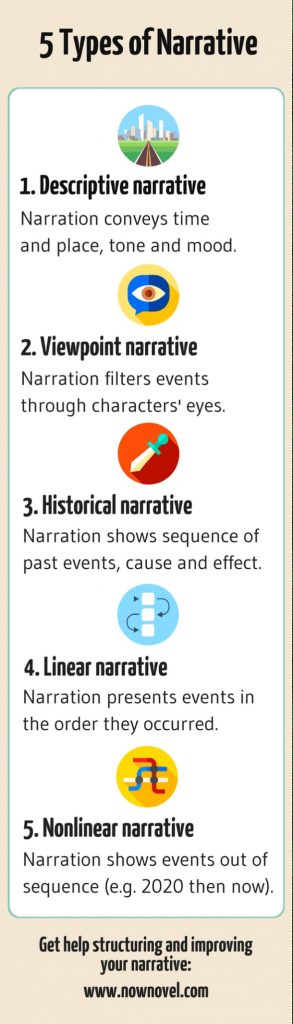
Common types of narrative:
- Descriptive narrative
- Viewpoint narrative
- Historical narrative
- Linear narrative
- Non-linear narrative
Let's explore each narrative type with examples:
Descriptive narrative
Descriptive narrative connects imagery, ideas, and details to convey a sense of fourth dimension and place.
The purpose of descriptive narrative
Descriptive narrative has two central purposes:
- To create a sense of setting, of time and place.
- To convey the mood and tone of said fourth dimension and place (e.thousand. threatening, peaceful, cheerful, cluttered).
When we describe a pastoral scene in a rural setting, for case, we might linger on specific images (such as a broad, empty field, an abandoned tractor) to build upwardly an overarching mood (such as peaceful simplicity).

Brainstorm story setting details
Come up with ideas for your descriptive narration by answering easy, stride-by-step prompts.
LEARN More
Descriptive narrative examples
The Colombian writer Gabriel Garcia Marquez is a master of this blazon of narration. In Honey in the Time of Cholera(1985), the third person narrator describes the unnamed seaside metropolis in the Carribbean where much of the novel takes place. Marquez narrates the passage through the eyes of Dr. Urbino, one of the city's well-nigh distinguished doctors:
The city, his city, stood unchanging on the border of time: the same burning dry out city of his nocturnal terrors and the lonely pleasures of puberty, where flowers rusted and salt corroded, where nothing had happened for iv centuries except a slow aging amidst whithered honor and putrefying swamps. In winter sudden devastating downpours flooded the latrines and turned the streets into sickening bogs. (p. 16-17)
In the infinite of a paragraph, Marquez shows how the city changes (or doesn't modify) over centuries. This makes Marquez'south setting more brilliant and real. The narration passes from showing the city's history to its citizens' current ways of life. The narrator proceeds to describe the lives of poor inhabitants:
During the weekend they danced without mercy, drank themselvesbullheaded on abode-brewed alcohol, fabricated wild love among the icaco plants, and on Sunday at midnight they bankrupt up their own party with bloody gratuitous-for-alls. (p. 17)
Over the form of ii pages, Marquez masterfully shows the city'south mood, culture, unique spirit. His narration and then zooms in closer on individuals' lives. The multiple time-scales in his narrative – past and nowadays 24-hour interval – combine to give a rich sense of fourth dimension and place.
ii: Viewpoint narrative
Often, the express purpose of a section of narration is to aid us empathize the views and feelings of the narrating character or 'viewpoint narrator'. Indicate of view or POV is thus a fundamental element of narration (read about dissimilar types of POV here and a definition of narration hither).
The purpose of viewpoint narrative
Viewpoint narrative presents events or scenes to us and then that nosotros run across understand them through narrators' feelings, desires, beliefs or values.
In all-seeing narration, the narrator is able to share multiple characters' individual thoughts, even in a unmarried scene. In express narration, past contrast, we tin can but see events through a single person'south eyes at a time. [You can read more about different points of view here.]
Viewpoint narrative has power. We might interpret story events the way the narrator does. Because nosotros don't accept a dissimilar viewpoint for comparison, or because their voice is strong, self-assured. Yet the viewpoint narrator in a scene may be unreliable (they could lie virtually what truly happened, or gloss over details that, for example, make them look worse to others).
Authors like Vladimir Nabokov take written novels featuring protagonists who are unethical or fifty-fifty abusive. In novels such as Nabokov'southLolita, the reader has to remember that the narrating voice has its own calendar.
Viewpoint narrative example
Virginia Woolf is a primary of filtering events via individual characters' perceptions. She frequently switches betwixt multiple characters' viewpoints within a single page. This approach (called 'stream of consciousness') lets her reveal characters' different fixations and personalities.
Take, for case, this scene in Mrs Dalloway (1925). Septimus Smith is a Earth State of war I veteran whose mental health is crumbling. His Italian wife Rezia feels unease and longs for her home country. Woolf switches from paragraph to paragraph between Septimus and Rezia's viewpoints, in tertiary person:
Human being nature, in brusk, was on him – the repulsive brute, with the blood-crimson nostrils. Holmes was on him. Dr. Holmes came quite regularly every day. In one case yous stumble, Septimus wrote on the dorsum of a postcard, homo nature is on you. Holmes is on you. Their simply run a risk was to escape, without letting Holmes know; to Italian republic – anywhere, anywhere, away from Dr. Holmes.
Virginia Woolf, Mrs Dalloway (1925), p. 81
Then to Rezia's POV in limited 3rd person:
But Rezia could non empathize him. Dr. Holmes was such a kind man. He was and so interested in Septimus. He but wanted to help them, she said.
Woolf, p. 81.
Woolf'due south gift for narrative means that she can narrate individuals' fears and obsessions within a single page without breaking the flow. Woolf reports Rezia's words within narration, instead of using dialogue. This allows Woolf's narrative (and irresolute viewpoints) to menstruum into each other without suspension.
3: Historical narrative
In genres such as biography, autobiography and various historical subgenres (due east.g. historical romance or WWII fiction), a lot of narration recounts events in the past. Of course, the author may choose to tell a state of war story in a tumultuous present tense. There's nounmarriedfashion to narrate the past. Nonetheless it serves a common purpose:
Historical narrative instance
1 thing common to historical narrative in different genres is it shows historical procedure. It links causation from event to upshot, showing the chain reactions that lead to how things pan out.
This is why in historical narrative, such as narration sharing a character's backstory, we often havewords showing order of events. Such equally the words bolded in this instance:
Showtime,the city was a fledgling thing.In the early on days, at that place was one traffic low-cal, and if you were doing your driver's license, you could exist damned certain you'd have to drive past it.In later years, equally the local publishing industry grew, it became a hotbed of hotshot journalists-in-training.So the urban center neededmore than traffic lights (and the related tender abuse to write most).
A sense of historical cause and effect, oflong stretches of time condensed,is typical of historical narrative.
Historical narrative and time words
Arundhati Roy's novel The God of Minor Things(1997), about tragedies that strike twin siblings born in Ayemenem in India and their family, is full of rich historical narration. Note the phrases and words that convey fourth dimension's passage, e.k. 'Vi months later…'.
Rahel was first blacklisted in Nazareth Convent at the age of eleven,when she was caught outside her Housemistress'southward garden gate decorating a knob of fresh cowdung with small flowers. At Assembly the side by side morning, she was made to look upwards depravity in the Oxford Dictionary and read aloud its meaning.
Arundhati Roy, The God of Minor Things (1997), p. 16
Roy proceeds to narrate Rahel'due south expulsion, revealing Rahel's inquisitive mind in the process:
Six months subsequently she was expelled after repeated complaints fromsenior girls. She was defendant (quite rightly) of hiding backside doors and deliberately colliding with her seniors. When she was questioned by the Principal about her behaviour (cajoled, caned, starved), she eventually admitted that she had done information technology to find out whether breasts hurt.
Roy, p. xvi.
Through narrating events in the past, in Rahel's schooling, Roy fleshes out a sense of her grapheme. She shows her inquiring, rule-breaking nature while likewise showing the strict social properties that conflicts with it. Past narrating Rahel'southward history, or backstory, Roy foreshadows future conflicts between Rahel's individualism and guild's expectations.
iv: Linear narrative
Linear narrative is narration where you tell events in the order they happened, i.due east. in sequence. This type of narrative is typical of realist fiction where the writer wants to create the sense of a life unfolding as a character experiences day to twenty-four hours or year to year.
The purpose of linear narrative
Linear narrative shows causation clearly. When nosotros see what happened to a character yesterday, and then today, then tomorrow, its often easier to notice patterns and chains of cause and consequence.
Stories told in a linear time-frame might be told mainly using past, nowadays, or even future tense. However each event flows on simply from the previous incident described. Frequently this helps to create what Will Self calls 'the texture of lived life', as we encounter characters going through this, then that, then the adjacent matter.
Case of linear narrative
David Mitchell's genre-bending Cloud Atlas(2004) spans multiple eras, settings and characters, and is nonlinear equally a whole. Yet ane section of his volume, titled 'Half-Lives – The First Luisa Rey Mystery' is written as a mystery/thriller. This section in itself is linear narrative, told in the nowadays tense.
Luisa Rey is a young journalist who becomes a target of powerful people when she investigates wellness and safety failings at a nuclear power plant.
Mitchell creates suspense and tension by placing Luisa's narration in third person and the present tense. The present tense narrative creates a sense of immediate action, unfolding now. Mitchell also creates tension by separating Rey's inner monologue from events happening around her:
Luisa Rey hears a clunk from the neighbouring balustrade. 'Hello?' Nobody. Her tum warns her to set down her tonic water. Information technology was the bathroom y'all needed, not fresh air, only she tin't face weaving back through the party and, anyway, at that place'south no time – down the side of the building she heaves: in one case, twice, a vision of greasy chicken, and a tertiary time.
David Mitchell, Cloud Atlas (2004), p. 90.
The linear chain of events – feeling uneasy and ill at a party, getting sick – occur on a simple timeline of 'this happens, and so that'.
5: Nonlinear narrative
Different types of narrative include narration that does not follow events in the order they happened.
Chronological events (e.one thousand. what happens in 1990 followed by what happens in 1991) don't have to match up with the social club ofnarrativeevents. The author might share primal details from 1990 earlier going back to the events of 1987 in the story.
However, as novel writing jitney Romy Sommer says, avert making the get-go several capacity of your novel all backstory:
An consequence I run across with a lot of beginner writers is they tend to write the backstory equally the story itself. If you do observe yourself writing the start few chapters being all about the backstory […] yous may demand to ditch the first few chapters.
Romy Sommer, 'Agreement character arcs: How to create characters', webinar preview here.
The purpose of non-linear narrative
Non-linear narrative has various uses:
- Information technology tin represent the narrator'south emotional state or consciousness. For example, a severely traumatized narrator who has flashbacks might tell events in a jumble of capacity gear up in different years, out of sequence, every bit they try to piece together fragments and memories.
- It can testify stories with related arcs or themes unfolding in different places and times.In Michael Cunningham's retelling (of a sort) of Woolf's Mrs Dalloway, characters living in different time periods have personal experiences and tragedies that echo events from Woolf's book too as Woolf'south own life.
- Information technology tin build suspense.For instance, Donna Tartt opensThe Secret History by telling the reader about a murder. Nosotros next meet the murder victim alive, as the story jumps back to the events leading to his killing.
Example of nonlinear narrative
Donna Tartt'south prologue to The Secret History(1992) is a masterful slice of not-linear narration. Within the first page, we know there's been a murder and the first person narrator is somehow complicit. Tartt's opening paragraph reveals a lot merely even so builds anticipation:
'The snow in the mountains was melting and Bunny had been dead for several weeks earlier nosotros came to sympathize the gravity of our state of affairs. He'd been dead for ten days earlier they institute him, you know. Information technology was one of the biggest manhunts in Vermont history – state troopers, the FBI, fifty-fifty an army helicopter; the higher closed, the dye manufactory in Hampden shut down, people coming from New Hampshire, upstate New York, equally far abroad as Boston.' (p. ane)
Yet adjacent thing we know, nosotros're back in the days when the narrator beginning met Bunny, and Bunny Corcoran is very much alive. This non-linear recalling of events gives u.s. a dramatic moment before its buildup. Yet Tartt still delays our complete gratification by making us wait for full understanding of what happened, and why.
Utilize examples of narrative to improve your own narration
Read through the examples of narrative higher up and try exercises based on these authors' narrative styles and techniques:
1. Write a paragraph of historical narrativedescribing a character's home city and how it has inverse over the years. In the side by side paragraph, draw how a character or section of the population spends a typical weekend in the metropolis, showcasing more of the metropolis's unique details.
ii. Write a scene using viewpoint narrativeshowing 2 characters preoccupied with different worries, in the third person. Write the scene entirely in narration. Any spoken language must be reported speech and non dialogue. For example: 'He told her that he was tired of the city and was thinking about moving away.' In the offset half, filter narration through the starting time character's thoughts, only and so switch to the other character'southward betoken of view. How do they run across things differently?
Does your skill in narration need developing? Our writing coaches will help you craft amend narrative.
stapletonlonot1975.blogspot.com
Source: https://www.nownovel.com/blog/narrative-examples-strong-narration/
0 Response to "New Types of Art That Emphasized Emotional Impact Over Descriptive Accuracy"
แสดงความคิดเห็น